
Introduction of EN1092-1 Flange Sealing Face
EN1092-1 is the key European standard for steel flanges, covering nominal diameters DN10 to DN2000 and nominal pressure ratings PN6 to PN100. The sealing face design is one of the most important factors that affect sealing performance, gasket compatibility, assembly stability, and service life.
EN1092-1 standard defines eight standardized sealing face types: Type A, Type B, Type C, Type D, Type E, Type F, Type G, and Type H. Each type has a fixed structure, dimension, and matching rule. This article provides a complete and clear introduction to all eight EN1092-1 flange sealing face types for engineering, procurement, and industrial application.
What are EN1092-1 Flange Sealing Faces?
Flange sealing face is the contact area between two mating flanges and the gasket used to achieve a leak-tight joint. EN1092-1 specifies strict geometric dimensions, surface finish, machining tolerances, and pairing rules to ensure interchangeability between flanges from different manufacturers.
The eight official sealing face types are:
- Type A: Flat Face
- Type B: Raised Face
- Type C: Tongue
- Type D: Groove
- Type E: Spigot
- Type F: Recess
- Type G: O ring Spigot
- Type H: O ring Groove
Among them, Type A and Type B are single sealing faces used between identical faces. Types C/D, E/F, and G/H are paired designs that must be used together.
EN1092-1 Flange Sealing face: Type A – Flat Face
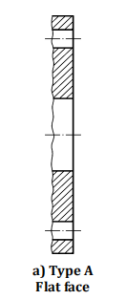
Type A is the Flat Face sealing face. The entire surface is flat and level with the bolting face of the flange, with no raised or recessed structure.
This type is mainly used in low-pressure systems such as PN6, PN10, and PN16. It requires full-face gaskets that cover the entire contact area. Type A is simple in structure, easy to machine and install, and widely used in water supply, air pipelines, and general utility services. It is not recommended for high pressure, fluctuating loads, or hazardous fluid services.
EN1092-1 Flange Sealing face: Type B – Raised Face
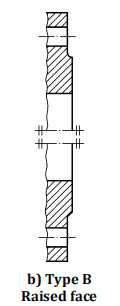
Type B is the Raised Face sealing face, the most widely used type in EN1092-1 flanges. It features a raised circular sealing area that concentrates gasket compression and improves sealing efficiency.
According to EN 1092-1, the standard facing height for Type B (Raised Face) is determined by nominal diameter (DN):
- 2 mm: ≤ DN 32
- 3 mm: DN 32 to DN 250
- 4 mm: DN 250 to DN 500
- 5 mm: DN 500
The surface is usually machined with a serrated finish to enhance gasket grip. It is compatible with spiral wound gaskets, graphite gaskets, non-asbestos gaskets, and PTFE gaskets.
Type B is suitable for medium to high-pressure systems and widely applied in oil and gas, chemical, power generation, process piping, and general industry.
EN1092-1 Flange Sealing face: Type C – Tongue
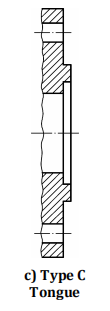
Type C is the Tongue face, which is always used together with Type D (Groove). It has a small, raised rectangular profile at the center of the sealing area.
This structure provides automatic centering and effectively prevents gasket extrusion or blow-out under pressure. Type C is typically used in critical applications such as refineries, chemical plants, and systems handling toxic, flammable, or high-pressure fluids.
EN1092-1 Flange Sealing face: Type D – Groove
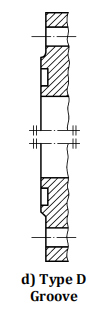
Type D is the Groove face, which forms a Tongue and Groove pair with Type C. It has a recessed channel that matches the tongue of Type C.
The combination ensures high sealing stability and eliminates gasket displacement during assembly. Type D is widely used in high-integrity process lines where zero leakage is required.
Type E – Spigot
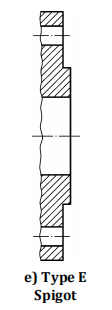
Type E is the Spigot face, used in combination with Type F (Recess). It has a cylindrical raised projection that helps align the flange during installation.
This type improves sealing stability under vibration and thermal cycling. It is commonly used in medium-pressure oil, gas, steam, and process piping systems.
Type F – Recess
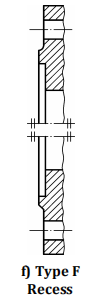
Type F is the Recess face, which matches with Type E to form a Spigot and Recess assembly. It has a cylindrical recess that receives the spigot of Type E.
This pairing provides accurate self-alignment and reduces gasket side slip. It is widely used in industrial pipelines, mechanical equipment, and systems subject to vibration.
Type G – O-ring Spigot
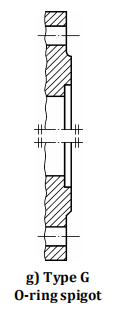
Type G is the O-ring Spigot face, designed for use with Type H and elastomer O-rings. It has a special protruding profile that holds the O-ring in place.
This type provides reliable sealing with low assembly force and is widely used in gas systems, vacuum applications, instrumentation lines, and special fluid services.
Type H – O-ring Groove
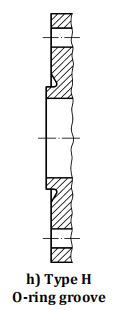
Type H is the O-ring Groove face, which forms a pair with Type G for O-ring sealing. It has a precision-machined groove to accommodate the O-ring.
This design offers excellent sealing performance under varying pressure and temperature conditions. It is commonly used in special equipment, hydraulic systems, and process units requiring elastomer sealing.
Comparison of EN1092-1 Sealing Face Types
- Type A: Flat Face, low pressure, full-face gaskets, utility systems
- Type B: Raised Face, general-purpose, most widely used in industry
- Type C/D:Tongue and Groove, high tightness, critical and hazardous services
- Type E/F: Spigot and Recess, self-aligning, vibration-resistant applications
- Type G/H: O-ring Spigot and Groove, elastomer sealing, special services
All types comply with the dimensional and tolerance requirements of EN1092-1 standard.
Conclusion
EN1092-1 defines eight standardized sealing face types: Type A, B, C, D, E, F, G, H to meet the requirements of various industrial piping systems. Type A and Type B are the most common for general applications, while Type C/D, E/F, and G/H are professional paired designs for high-safety, vibration, and special sealing conditions.
Understanding the structure, characteristics, and applications of each type is essential for correct flange selection, proper gasket matching, and long-term, leak-free piping connections.